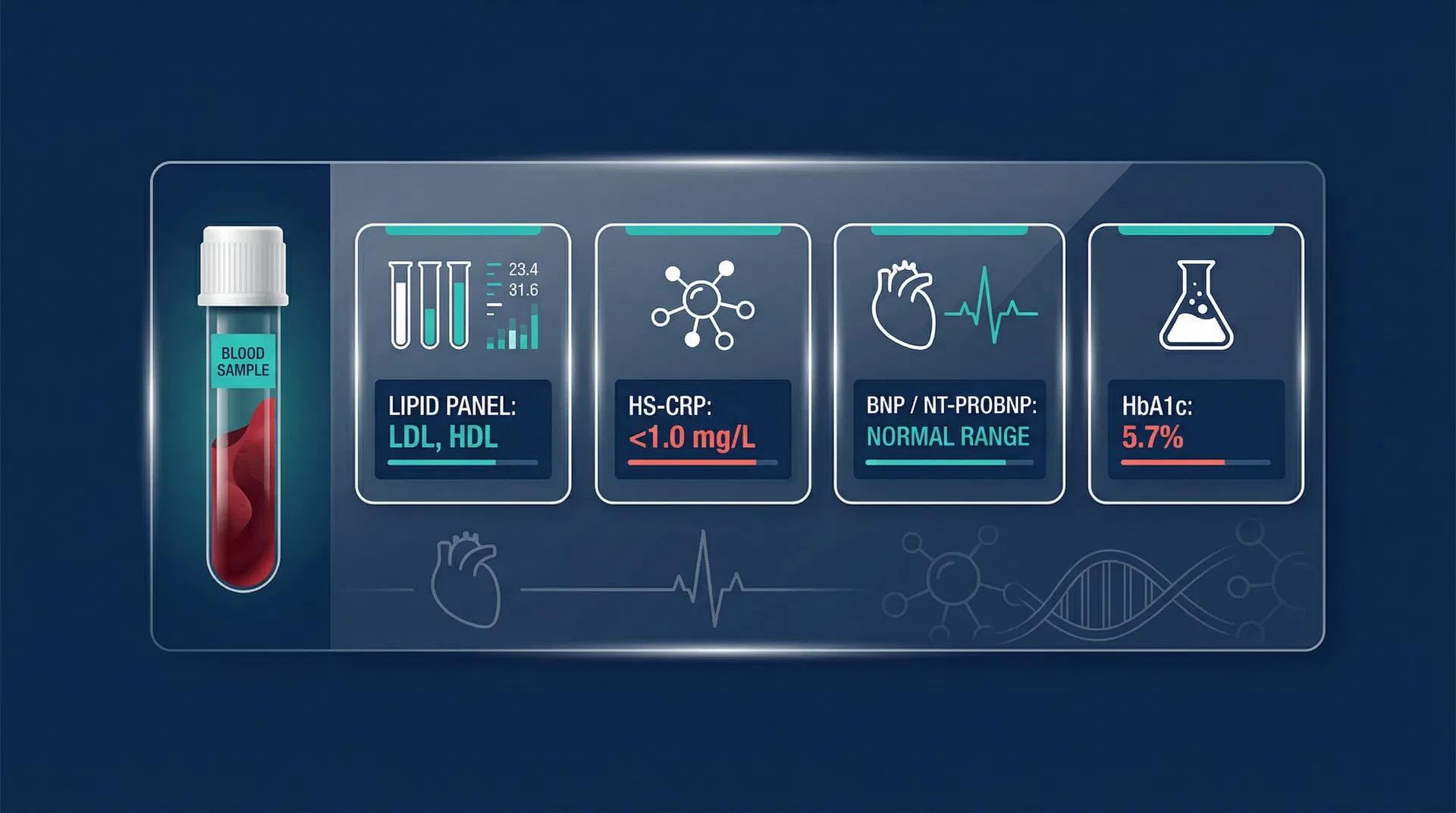
Know Your Numbers: 5 Key Labs for Heart Health
Know Your Numbers: 5 Key Labs for Heart Health (a preventive cardiologist's perspective)
When you get bloodwork, it's easy to focus on one number, usually LDL cholesterol. But cardiovascular risk is rarely a single-number story.
In preventive cardiology, I look for a pattern: blood sugar, kidney function, inflammation, and most importantly, the number of cholesterol particles that can enter the artery wall and build plaque.
Here are five high-yield labs I want most adults to know, along with how to interpret them and what to do next.
Key idea: The earlier we identify risk, the easier it is to prevent heart disease, not chase it.
1) CMP (Comprehensive Metabolic Panel)
The CMP is not a "heart test," but it quietly contains several clues about cardiometabolic health.
What it tells us:
- Kidney function (creatinine, eGFR): chronic kidney disease is a major cardiovascular risk enhancer.
- Electrolytes (sodium, potassium, bicarbonate): relevant for blood pressure management, diuretic therapy, arrhythmia risk.
- Liver enzymes (AST/ALT): can hint at metabolic-associated fatty liver disease (MAFLD), which travels with insulin resistance and higher ASCVD risk.
- Glucose (fasting): a piece of the glycemic picture (paired with A1c).
How I use it:
- If kidney function is abnormal, it changes BP goals, medication choices, and overall risk.
- Elevated liver enzymes in the right context may point to metabolic dysfunction and prompt deeper evaluation.
2) Lipid Panel (including non-HDL cholesterol)
Most people know total cholesterol and LDL‑C, but the lipid panel has more to offer.
Key components:
- LDL‑C: cholesterol mass in LDL particles (important, but not the whole story).
- HDL‑C: often called "good cholesterol," but higher isn't always protective; context matters.
- Triglycerides: a marker of insulin resistance and metabolic health, especially when elevated.
- Non‑HDL‑C: total cholesterol minus HDL; captures all atherogenic cholesterol (LDL, remnants, Lp(a), etc.).
Why non‑HDL matters: Non‑HDL is often a better "all‑in" target than LDL‑C alone, particularly when triglycerides are elevated.
3) ApoB (Apolipoprotein B)
If I had to pick one "advanced" lipid marker to add for many patients, it's ApoB.
Why it matters:
- ApoB reflects the number of atherogenic particles (LDL, VLDL, remnants, and Lp(a)).
- Atherosclerosis is driven by particle entry into the artery wall; particle number is the exposure dose.
- ApoB is especially helpful when LDL‑C looks "normal" but risk is not (metabolic syndrome, diabetes, high triglycerides).
Practical interpretation (general targets):
- Lower is better, especially in higher‑risk patients.
- Many guidelines and expert consensus statements support ApoB as a strong risk marker and treatment target, particularly when triglycerides are elevated or discordance is suspected.
4) Lp(a) [Lipoprotein(a)]
Lp(a) is a genetically determined cholesterol particle that increases risk for:
- coronary artery disease
- stroke
- aortic valve stenosis
Two key facts:
- It's largely not changed by lifestyle.
- You typically only need to check it once in a lifetime (unless you're monitoring in special situations).
When I'm especially interested:
- strong family history of premature heart disease
- unexplained early heart disease despite "normal" cholesterol
- recurrent events or high calcium score out of proportion to traditional risk factors
Typical thresholds (lab dependent):
- Many labs flag elevated risk at ≥50 mg/dL or ≥125 nmol/L.
5) hs‑CRP (High-sensitivity C-reactive protein)
hs‑CRP is a marker of systemic inflammation. It's not specific to the heart, but it can help refine risk, especially when you're on the fence.
How I use it:
- Persistent elevation can identify higher inflammatory risk, support intensifying lifestyle/medical therapy, and in select cases influence statin decisions in intermediate‑risk patients.
- It's also a reminder: sleep, stress, visceral fat, periodontal disease, and chronic inflammatory conditions all influence risk.
Important caveat: hs‑CRP rises with infection, injury, and acute illness, so timing matters.
Putting it together: "pattern recognition" in prevention
Here's a simplified way to think about it:
- CMP: organs + metabolic context
- Lipid panel + non‑HDL: baseline lipid risk
- ApoB: particle number (the dose that drives plaque)
- Lp(a): inherited risk you can't lifestyle away
- hs‑CRP: inflammation and residual risk
If you know these numbers, you can have a much higher-quality conversation with your clinician about prevention.
What should you do next?
- Ask for a copy of your labs and keep them in one place.
- If you've never checked it, ask about ApoB and Lp(a).
- Don't interpret labs in isolation; pair them with blood pressure, family history, and (when appropriate) imaging like a coronary calcium score.
- Use results to guide action: nutrition, activity, sleep, weight, and medications when indicated.
References (IG-friendly)
- Arnett DK, et al. 2019 ACC/AHA Guideline on the Primary Prevention of Cardiovascular Disease. Circulation. 2019.
- Mach F, et al. 2019 ESC/EAS Guidelines for the management of dyslipidaemias. Eur Heart J. 2020.
- Grundy SM, et al. 2018 AHA/ACC Guideline on the Management of Blood Cholesterol. Circulation. 2019.
- Tsimikas S. A test in context: Lipoprotein(a). J Am Coll Cardiol. 2017.
- Ridker PM. C-reactive protein and cardiovascular risk. Circulation. 2003.
Ready to optimize your cardiovascular health?
Schedule a comprehensive preventive cardiology consultation to discuss your personalized risk reduction strategy.
Book a Consultation
